
The Architecture of Access
When Artificial Intelligence Becomes the Gateway to Human Memory
Part II of a two-part inquiry · Read Part I: From Oral Tradition to Artificial Intelligence
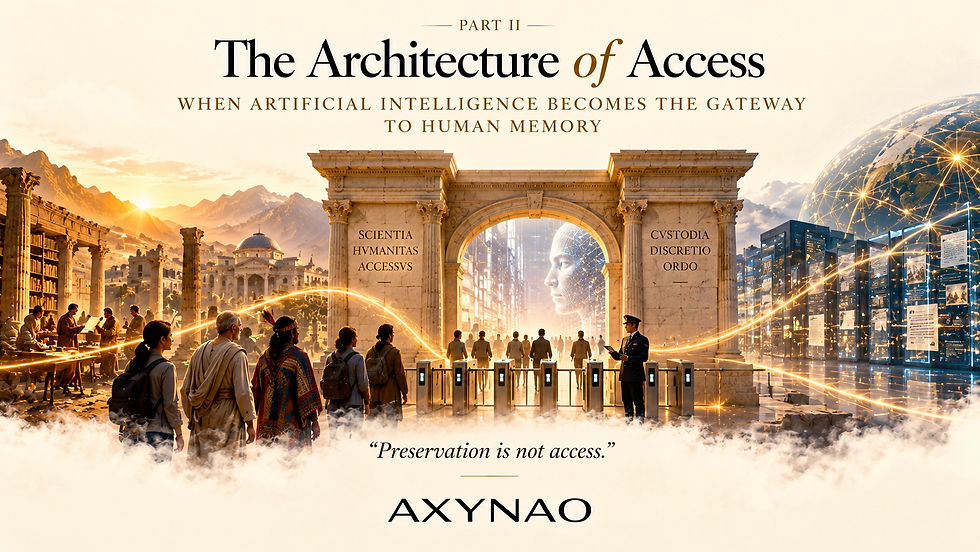
Memory Survived. Can We Still Reach It?
Part I of this inquiry made a claim about what must survive: that memory is future optionality, and that knowledge allowed to lapse is not merely lost to the past but foreclosed for the future. It ended where this essay must begin, with a harder question. Suppose the memory survives. Suppose nothing is destroyed. Is it therefore reachable?
The two are not the same thing, and the gap between them is widening. A record can exist in perfect condition and be, for every practical purpose, unavailable — because no one can find it, open it, read it, or is permitted to. Preservation answers the question “does it still exist?” Access answers a different one: “can anyone still get to it?” An institution can win the first and lose the second without noticing, because the collection looks intact the whole time.
The digital record makes the point with uncomfortable precision. A 2024 Pew Research Center study found that 38% of webpages that existed in 2013 were no longer accessible a decade later, and that 54% of Wikipedia pages carried at least one reference link pointing to a page that had vanished. The information was not deliberately destroyed; it simply stopped being reachable, one broken address at a time. Existence is not availability. The object can outlive the path to it.
This essay is about that path. If Part I was about the asset, this is about the gateway — and the central claim is blunt: preserved knowledge does not preserve optionality if the path to that knowledge becomes controlled, opaque, singular, or revocable. The question is no longer only who owns knowledge. It is who architects access to it.
The Interface Becomes the Gate
For most of history, reaching knowledge meant moving through a structure you could see. You searched a catalog, walked a stack, consulted an index, asked a librarian, followed a citation. The architecture of access was plural and inspectable: many paths led to many sources, and you could tell, roughly, how you had arrived.
That is changing faster than almost anything else in the knowledge system, and it is changing at the layer Part I named — the model is the interface, not the archive. Increasingly we do not search; we ask. And the thing we ask returns not a field of sources to choose among but a single synthesized answer. The architecture between the human and the source has collapsed from a space you traverse into a gate you query.
The early data is stark. A Pew Research Center analysis of real Google searches found that when an AI-generated summary appeared at the top of the results, users clicked through to a traditional source link only 8% of the time, against 15% when no summary was shown — and they clicked a link inside the summary itself just 1% of the time. Across the open web the pattern compounds: industry web-traffic trackers put zero-click searches at roughly six in ten, with one widely cited measure finding the share of Google searches ending without any click rising from 56% to 69% in the year after AI summaries spread. For every thousand searches, a shrinking fraction now reaches a source at all.
And the narrowing is twofold. The single answer does not only reduce how often any source is reached; it concentrates which sources are reached at all. The same Pew analysis found that AI summaries drew a large share of their citations from a small set of platforms — Wikipedia, Reddit, and YouTube prominent among them — so that the field of sources a reader encounters contracts toward a handful of sites even on questions where the record is vast and various. A plural archive, seen only through a gateway that favors a few doors, becomes effectively a small one.
Notice what this does, structurally. It is not that the sources were destroyed; they are still there, dormant in Part I's sense. It is that the interface has become the place where the question is answered, and the plural field behind it has gone quiet. The gateway is no longer a space one moves through on the way to the sources. It is increasingly the destination. And whoever builds that gateway decides, query by query, which of the many sources a person will ever see — or whether they will see any.
Existence Is Not Availability
Between a thing's survival and its reachability sits a layer that rarely gets named: visibility. A document can exist, be perfectly legible, sit in a well-funded archive, and still be invisible — because it was never indexed, never digitized in a searchable form, never translated out of a language few now read, never ranked highly enough to surface, never retrieved by the system that now stands between people and the record.
This is Part I's “dormant” seen from the access side. The Oxyrhynchus papyri were legible for a century and unread at scale because no apparatus could activate them; the knowledge existed and was unavailable. The modern version is quieter and larger. When retrieval is mediated by a ranking model, what the model does not surface is, for the person asking, indistinguishable from what does not exist. Visibility becomes the operational form of access: not “is it there?” but “will it ever be shown?”
Translation is the quietest of these gates. A text can survive perfectly, be fully legible to those who read its language, and remain unreachable to everyone else — and when the languages that hold a body of knowledge are themselves endangered, the record can pass out of reach without a single page being lost. What is not rendered into a language the retrieval system reads is, increasingly, what the system cannot surface. The gate here is not a lock but a silence: the knowledge is there, speaking, and no one is listening in a tongue the machine will carry.
The consequence is that a new kind of loss becomes possible — loss without destruction. A record can be preserved flawlessly and rendered unreachable by the simple fact that nothing points to it anymore. The archive is full; the path is gone. And because the collection still shows as complete, the institution has no alarm to tell it that the access has quietly failed.
Access Is an Architectural Layer
It is worth stating the structure plainly, because the whole argument turns on treating access as architecture rather than convenience. Six things stand in a line, and each depends on the one before it.
Memory preserves the alternatives. Access determines which of them are reachable. Visibility determines which of the reachable ones actually enter human view. Optionality is the set of alternatives a person can still choose from. Decision turns one of those into reality. And the accumulated weight of such decisions, across a society and across generations, is what we call civilization. Memory, access, visibility, optionality, decision, civilization — a single chain, cut anywhere, fails everywhere downstream.
Part I established the first link and the fourth: memory as the stock of optionality. This essay is about the two in between — access and visibility — because they are where the chain is quietly being cut. A civilization can preserve everything and still narrow its future, if the layer that determines reachability is controlled by few, or opaque to all, or able to be switched off. Preserved memory that cannot be reached is optionality on paper. The decision space it was meant to keep open is, in practice, already closed.
When Access Becomes Captured
Here is the danger the chain exposes, and it arrives in two forms that look like opposites while doing the same damage. Access can be captured by concentration or by credential — by making the gateway singular, or by making it exclusive. Both foreclose optionality; one by monopoly, the other by membership.
Capture by concentration is the form most people half-expect: a single model, platform, or jurisdiction becomes the practical gateway to a domain of knowledge, and the plural paths wither because everyone uses the one. You can still own the archive in every legal sense while another party controls whether, how, and on what terms it can be reached. The clearest illustration is the live debate over frontier AI, where the proposal is explicit. A widely discussed governance paper recommends that governments require cloud providers to run Know-Your-Customer schemes on compute, treating cloud access as a chokepoint — and its own language is candid about the point of a chokepoint: it allows regulators to control quantities and to suspend access at any time. This is not hypothetical; the 2023 US executive order on artificial intelligence already directed the Commerce Department toward such reporting for cloud providers. The architecture of a chokepoint is the same whoever holds it: one hand on the valve, and the ability to close it.
Concentration does not require a statute to bite. It is already the ambient condition of the knowledge layer: a handful of firms train and operate the models most people will ever query, a handful of cloud providers hold the compute those models run on, and a research community that once imagined the internet would equalize access now speaks of a compute divide between the few institutions that can build at the frontier and everyone else. Europe’s Digital Markets Act names the largest platforms “gatekeepers” precisely because their position between people and information has become structural rather than incidental. When the gateway is already singular, no one needs to close the valve; it is enough to own it.
Capture by credential is subtler, and it is the one that hides inside the language of responsibility, because it looks like quality control rather than exclusion. Here the gate is not a monopoly but an entry ticket: a license, a paper, an accreditation, a required course, a membership, a circle one must belong to before the knowledge may be reached. The danger is not only that no one can reach the memory. It is that only a few can, because they hold the key — a new elite minted to stand where the knowledge had just been opened.
This pattern is well documented wherever it has been studied. Occupational licensing is the textbook case: the economists Morris Kleiner and Alan Krueger found that licensed workers earn roughly 18% more than comparable unlicensed ones, and that the share of the US workforce requiring a government license rose from about 5% in the 1950s to around a quarter by 2013 — a barrier to entry, in the plain terms the field has used since Friedman and Stigler, that raises the wages of those inside by keeping others out. The same shape governs the gatekeeping of research itself: a landmark study found that five commercial publishers came to produce close to half of all scientific papers, their grip tightening with the arrival of the very digital era that was supposed to loosen it — and when “open access” arrived as the remedy, much of it was promptly re-gated behind author-processing charges, a toll simply moved from the reader to the writer. In each case the knowledge exists and is, in principle, for everyone; in practice it is reachable only by those who can pay the toll or carry the card.
The impulse is older than any of these cases, and the sociology of it is well charted — credentialism, in Randall Collins’s sense, is how groups convert knowledge into social closure, turning a body of learning into a membership that raises the standing of those who hold it by excluding those who do not. The medieval guild guarded its craft with the apprenticeship and the masterpiece; the clergy guarded literacy itself for centuries; the learned professions guard entry with the diploma and the board. Each began, often sincerely, as a guarantee of quality, and each hardened into a wall. The reflex to meet a newly opened field of knowledge by minting a credential for it is not a modern invention; it is the oldest move in the history of access.
The two captures share one property that makes them equally corrosive to optionality: in both, the reachable set is defined by someone other than the person reaching. Concentration defines it by what the single gateway chooses to surface; credential defines it by who is permitted through. A future you cannot reach is foreclosed to you whether the barrier is a monopoly or a membership — and an institution that has preserved everything, under either regime, has preserved the record and surrendered the option.
There is a deeper reason the credential answer is so tempting and so wrong, and we argued it in an earlier essay: the old thresholds — the dragons at the gate — once did real work, forming judgment through the difficulty of the crossing, and their collapse under AI leaves that function unfilled. But the gate rebuilt as a license is the wrong answer to that absence. It restores the exclusion without restoring the formation. The missing threshold is not replaced by a turnstile.
The Press, and the Gate That Followed It
None of this is new, and the clearest precedent is the one closest to our own moment. When Gutenberg's press spread through Europe after 1450 it did exactly what AI is now credited with: it democratized access, mass-producing texts and dissolving the monopoly that clergy and guilds had held over the written word. And the authorities re-gated it almost immediately — not by destroying the technology, but by licensing it.
In England the Crown chartered the Stationers' Company in 1557 and handed a guild of printers a monopoly over the right to print, together with the duty to censor: its members could search out unlicensed books, seize them, destroy the presses, and imprison the printers. Rome maintained the Index Librorum Prohibitorum, its list of forbidden books, from 1559 until 1966. The Licensing of the Press Act of 1662 required that nothing be printed without prior approval and registration — pre-publication permission as the price of reaching the public — the regime against which Milton wrote the Areopagitica in 1644. And then the instructive ending: in 1695 Parliament simply declined to renew the licensing act, because, in its own words, it had never achieved what it was made for. The sheer volume of print had overwhelmed the gate, and the attempt to decide centrally who could reach knowledge was abandoned as unworkable.
The parallel is exact — your fear, four centuries early: a democratizing access technology met by authorities who rebuild the gate as a licensed membership, a chartered guild deciding who may print and an index deciding what may be read. It was capture by concentration and capture by credential at once, and it failed. The lesson is not that gates never return; it is that re-gating a technology whose whole effect was to widen access is both the predictable reflex and, historically, a losing and illegitimate one. (The scholarly anchor is Elizabeth Eisenstein's The Printing Press as an Agent of Change.)
Plural Gateways, Not a New Alexandria
So what is the alternative, if it is neither the frictionless single interface nor the rebuilt gate? The constructive answer is an architecture of plural access: not one gateway but many; preserved originals that can be consulted directly, not only through a model's paraphrase; provenance that travels with the record; transparent retrieval, so a person can see what was surfaced and what was not; and above all substitutability — the ability to leave one interface, provider, or jurisdiction without losing the underlying memory. A single magnificent gateway, however well built, is a new Library of Alexandria: a glory, and a single point of failure.
The LOCKSS and CLOCKSS preservation networks already encode the principle at the technical level: their governing rule is that many copies do not protect content if one administrator, one organization, or one software instance can reach them all, so no single participant controls every copy. Plural gateways apply the same logic to access — no single party should stand between a people and the whole of their memory.
Plurality is not only a matter of copies and providers; it is also a matter of keeping the original within reach. An architecture of access that deserves the name preserves the right to consult the source directly — to go behind the model’s paraphrase to the document itself — and builds the tools that let a community steward its own gateway rather than renting one. Community-governed access platforms already do this in practice, holding a people’s records under their own protocols and permissions rather than inside someone else’s search box. The point is not friction for its own sake, but to ensure that no single interface becomes the only way in.
But this is exactly where Part I's argument and this one appear to collide, and the collision must be resolved cleanly, because the resolution is the heart of the doctrine. Part I argued for governed access — that a community must be able to set the terms on which its own knowledge is shared, that sovereignty means holding the key. This essay argues against re-gating. How can both be true?
They are reconciled by a single distinction. The question is never whether there is a key. It is who holds it, and whether it is theirs to hold. A legitimate gate is one where the rightful custodian governs access to its own knowledge — the community the knowledge is from and about, setting the terms on which it is shared. That is sovereignty, and it is Elinor Ostrom's commons: durable shared resources are neither open field nor locked vault but governed by those with the standing to govern them. An illegitimate gate is one where a self-appointed elite erects a tollgate on knowledge that is not theirs, charging admission — in credentials, fees, or membership — to a commons it did not create and does not belong to. The first is custody. The second is rent extracted on reachability, wearing the uniform of stewardship.
So the test is not “gate or no gate.” It is “is the gatekeeper the custodian, or a tollkeeper?” A custodian holds the key to their own house. A tollkeeper has installed a turnstile on a public road. That single line lets an institution defend sovereignty and refuse credentialism in the same breath, without contradiction.
AI as a Technology of Reconnection
It would be a failure of nerve to end on the threat, because the same technology that can capture access can also widen it more than anything before — and that possibility is the reason the architecture matters. AI's distinctive power at this layer is relational: it can propose connections among dispersed records, languages, periods, artifacts, and communities that no single scholar could ever hold in view at once. Part I called this the Global Memory Expedition — the reassembly of knowledge that is fragmented rather than destroyed. Done well, the interface does not shrink the reachable set; it enlarges it, surfacing the source you would never have known to look for.
The whole question is which of those two things the mediation does: expand the reachable set, or quietly define it. An interface that widens access shows you more than you could have found and leaves you able to go to the source yourself. An interface that captures access shows you one answer and lets the plural field behind it fall silent. The technology is the same; the architecture decides which one you get. And the difference between them is precisely the difference between a gateway built by a custodian and a gate installed by a tollkeeper.
Who Architects Humanity’s Memory?
Which returns us to the civilizational question, now sharpened. For most of history the anxious question about knowledge was one of possession: who owns it, who hoards it, who has the library. That question has not disappeared, but it is no longer the decisive one. The decisive question is architectural: who determines what becomes reachable, visible, comparable — and therefore thinkable?
A civilization does not only lose its options when its memory is destroyed. It loses them, just as surely, when its memory is preserved but its access is captured — when a single interface defines what can be seen, or an entry ticket defines who may see it. The danger is not merely that no one can reach the record. It is that only a few can, because they hold the key to a house that was never theirs. Optionality held by a few is optionality foreclosed for everyone else, and a decision space narrowed by membership is as closed as one narrowed by fire.
So the question this essay leaves is not the old one. It is this: when the gateway to memory is built — and it is being built now — will it be a gateway a people can walk through and govern, or a gate that others open and close on their behalf? The answer will not be decided by who preserves the most. It will be decided by who architects the access.
No civilization can choose from possibilities it cannot remember — and it cannot remember what it cannot reach. The future of civilization will depend less on who owns knowledge than on who architects access to it. Memory preserves the possibilities. Access makes them reachable. Visibility makes them perceivable. Optionality makes them choosable. Decision turns them into reality.
Stoic Reflection
The Stoics drew one line through everything: what is up to us, and what is not. A road we may walk is freedom; a road another may close at will is not ours, however open it stands today. Knowledge we can reach only by another's leave is knowledge we do not yet possess — we hold the memory of it, and the hope of it, and nothing more. To architect access is to move the gate from their hands into our own.
Sources
The Access and Visibility Layer
Pew Research Center. “Google users are less likely to click on links when an AI summary appears in the results.” 22 July 2025. — The finding that with an AI summary present, users click a traditional source link 8% of the time against 15% without, and a link inside the summary only 1% of the time.
Pew Research Center. “When Online Content Disappears.” 17 May 2024. — Digital decay: 38% of webpages from 2013 are no longer accessible, and 54% of Wikipedia pages carry at least one dead reference link — existence is not availability.
Industry web-traffic analyses (Similarweb; SparkToro & Datos), 2024–2025. — Zero-click search measures: roughly six in ten Google searches end without a click to an outside site, a share that rose sharply as AI summaries spread.
Capture by Concentration
Janet Egan and Lennart Heim. “Oversight for Frontier AI through a Know-Your-Customer Scheme for Compute Providers.” Centre for the Governance of AI, 2023. — Proposes treating cloud compute as a regulatory chokepoint, with the ability to control quantities and suspend access at any time; US Executive Order 14110 (2023) already moved Commerce toward such reporting.
Capture by Credential
Morris M. Kleiner and Alan B. Krueger. “Analyzing the Extent and Influence of Occupational Licensing on the Labor Market.” Journal of Labor Economics 31, no. S1 (2013). — The empirical case that licensing is a barrier to entry: roughly an 18% wage premium, with the licensed share of the US workforce rising from about 5% to around a quarter between the 1950s and 2013.
Milton Friedman, Capitalism and Freedom (1962); George J. Stigler, “The Theory of Economic Regulation” (1971). — The classic account of licensure and regulation as devices that restrict entry on behalf of those already inside.
Randall Collins. The Credential Society: An Historical Sociology of Education and Stratification (1979). — Credentialism as social closure — how a body of learning is converted into a membership that raises the standing of those inside by excluding those outside.
Vincent Larivière, Stefanie Haustein and Philippe Mongeon. “The Oligopoly of Academic Publishers in the Digital Era.” PLOS ONE 10, no. 6 (2015): e0127502. — Five commercial publishers came to produce close to half of all papers, their share rising in the digital era; “open access” itself re-gated through author-processing charges.
The Historical Mirror
Elizabeth L. Eisenstein. The Printing Press as an Agent of Change. Cambridge University Press, 1979. — The scholarly anchor for the press as a democratizing technology that was promptly re-gated.
The Stationers’ Company (royal charter, 1557); the Index Librorum Prohibitorum (1559–1966); the Licensing of the Press Act 1662; John Milton, Areopagitica (1644); the lapse of licensing in 1695. — The licensing of print — a chartered guild deciding who may print and an index deciding what may be read — and its eventual abandonment as unworkable.
The Constructive Architecture
LOCKSS / CLOCKSS (Stanford Libraries; CLOCKSS Archive). — The principle of plural control: many copies do not protect content if one administrator can reach them all, so no single participant controls every copy.
Elinor Ostrom, Governing the Commons (Cambridge University Press, 1990); Charlotte Hess and Elinor Ostrom, Understanding Knowledge as a Commons (MIT Press, 2007). — Governed access, not enclosure — the basis for distinguishing a custodian’s legitimate key from a tollkeeper’s turnstile.
Michel-Rolph Trouillot, Silencing the Past (Beacon Press, 1995). — Power shapes which records survive and surface — the case for distributing control over access, not only storage.
AXYNAO Essays Referenced
AXYNAO. From Oral Tradition to Artificial Intelligence: Memory as the Architecture of Future Optionality. 2026. — Part I — memory is future optionality; the asset whose gateway this essay examines.
AXYNAO. After the Dragon Is Gone. 2026. — The formative threshold whose collapse under AI this essay extends into the access layer — and why the gate rebuilt as a license is the wrong answer.
AXYNAO. The Institutional Knowledge Custody Covenant; the Epistemic Sovereignty Quadrant. 2026. — The published instruments that set the standard for provider-independent custody and measure whether an institution governs its own standing.
AXYNAO Reflection
AXYNAO builds the architectures through which meaning survives — and through which it remains reachable. A memory that cannot be reached is a possibility already spent. To keep the path open, and in the right hands, is to keep the future's options its own.
AXYNAO / Erik Kling, “Diplom Oekonom” University Of Hohenheim
Architecture Determines Meaning — Speaking & Advisory
Tags: Architecture of Meaning · Access · Optionality · Artificial Intelligence · Knowledge Governance · Epistemic Sovereignty · Gatekeeping


Comments