
The AXYNAO Institutional Knowledge Custody Covenant

The AXYNAO Institutional Knowledge Custody Covenant defines ten requirements for preserving source access, provenance, institutional control and human optionality in the age of artificial intelligence.
Ten requirements for preserving human memory in the age of artificial intelligence
Knowledge institutions are entering a transition more consequential than the digitization of the library.
Universities, archives, museums, research institutes and publishers are beginning to place their collections, data, scholarly records and institutional memory inside artificial-intelligence systems. The promise is considerable. AI can help people discover material that would otherwise remain hidden, translate knowledge across languages, connect distant fields, summarize complex records and make vast archives more usable.
But a deeper architectural shift is taking place at the same time.
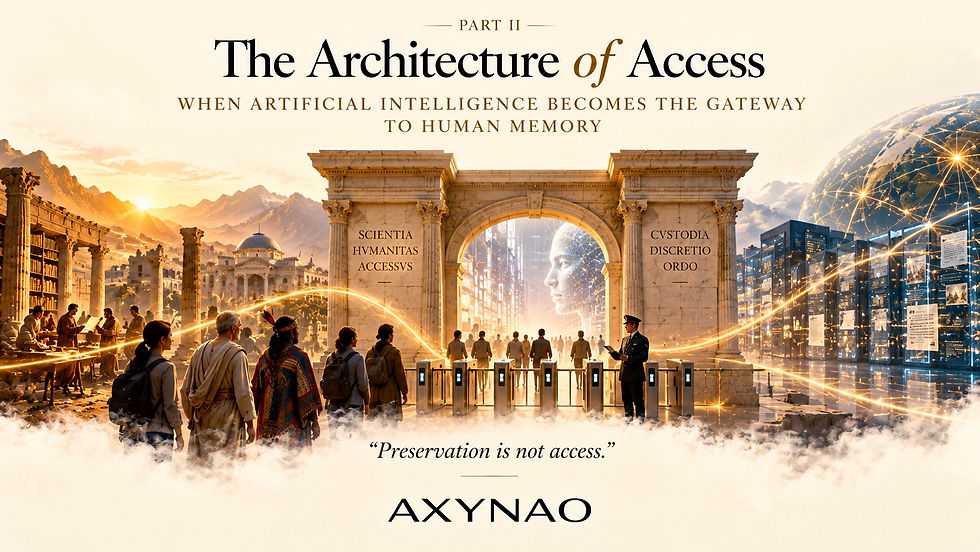
The institution may continue to own the source while losing control of the path through which the source is found, interpreted and remembered. Access may move from the archive to the interface. Provenance may be replaced by synthesis. A document may continue to influence an answer even when the user can no longer reach the document itself. Its influence may survive statistically while the source, context and chain of custody disappear from practical view.
This is not only a technology problem. It is a civilizational one — and it is already underway. The Architecture of Captured Memory traced it in the mass acquisition of the world's forgotten books, where the knowledge remains but its custody quietly changes hands."
An institution entrusted with human knowledge has a duty not merely to preserve information, but to preserve humanity’s ability to return to the source, inspect the evidence, understand the context, encounter disagreement and reach a different judgment.
That duty cannot be delegated silently to an AI provider.
The governing principle is therefore simple:
The model must never become the archive.
Artificial intelligence may become an interface to the archive. It may help discover, translate, connect, summarize, analyze and interpret. But the original materials, metadata, provenance, context and institutional custody must remain independently accessible.
This is the purpose of the AXYNAO Institutional Knowledge Custody Covenant.
It defines the minimum requirements every knowledge institution should impose on any AI provider, cloud provider, retrieval system, publishing platform or technical partner that touches its institutional memory.
Intellectual foundations—and the AXYNAO contribution
The Covenant does not claim that archival provenance, digital preservation, repository trust, community authority, responsible AI or technology portability begin here.
UNESCO’s documentary-heritage work, research-library AI principles, trusted-repository standards, Indigenous data-governance frameworks and current content-provenance initiatives have developed essential parts of this field.
The broader phrase knowledge custody is also appearing in enterprise-AI discussions to describe an organization’s ability to keep its accumulated knowledge inspectable, portable and repairable outside a vendor’s platform.
The AXYNAO contribution is the integration of these established principles into a single institutional covenant for the AI age: a standard that joins source preservation, provenance, direct access, interpretive plurality, provider substitutability and audit rights—and connects them to epistemic sovereignty and human optionality. The forthcoming AXYNAO Epistemic Sovereignty Monitor is designed to make that integrated responsibility observable over time.
Why knowledge institutions must remain the custodians
Throughout history, the custody of knowledge has moved with power.
Royal courts assembled libraries. Kings and queens financed collections, scholars and archives. Monastic communities copied manuscripts and preserved languages, histories, philosophy and scientific thought that might otherwise have disappeared. Religious authorities protected bodies of memory across centuries. Universities gradually assumed part of that responsibility as institutions capable of carrying inquiry, evidence and interpretation beyond the life of a ruler, donor or individual scholar.
Times change. The responsibility changes with them.
Today, knowledge and memory institutions—including universities, libraries, archives, museums, independent research institutes and durable community repositories—are the institutional class whose public purpose is most explicitly built around combining:
intergenerational continuity;
preservation of original sources;
disciplined inquiry;
competing interpretations;
peer challenge;
public stewardship;
succession beyond any individual custodian.
This does not mean that governments, corporations, religious institutions or private individuals have no role in preserving knowledge. They have often played indispensable roles, and they may continue to finance, support, digitize and expand access to human memory.
But they must not become its exclusive custodians.
A government may preserve knowledge while also possessing the power to classify, suppress, alter or erase it.
A corporation may build extraordinary infrastructure for access, but its obligations are commercial, its ownership can change, and its services can be discontinued.
A private individual may preserve an important collection, but cannot by themselves reliably guarantee succession, durable access or institutional accountability.
A religious authority may safeguard invaluable memory, but may also govern interpretation through doctrine.
An artificial-intelligence provider may help humanity navigate and interpret knowledge, but it has neither the civilizational mandate nor the institutional legitimacy to become the final custodian of the record.
These actors may support custody. They must not become the exclusive architecture through which civilization is permitted to remember.
Knowledge institutions therefore carry a distinct civilizational mandate:
to preserve the source without claiming exclusive authority over its meaning;
to protect competing interpretations;
to keep the record available across changes in technology and power;
to maintain continuity beyond any individual leader, government, donor or company;
to ensure that no government, corporation, religious authority, artificial-intelligence provider or private person becomes the sole gateway through which humanity can reach its own memory.
The governing principle is:
The custodian of civilization must be an institution capable of surviving the custodian.
That is why the obligations in this Covenant belong first to knowledge institutions. They are not automatically sovereign, neutral or incorruptible. The forthcoming AXYNAO Epistemic Sovereignty Monitor will examine precisely whether they possess the independence, architecture and custodial integrity required to fulfill this responsibility.
The demand is not unrestricted access to every piece of data ever used by an AI company. That would be technically imprecise and could violate legitimate privacy, copyright, cultural-stewardship and security protections.
The demand is more exact:
Every institution must retain complete custody, portability, provenance and source-level access for the knowledge it contributes or entrusts to an AI system, together with sufficient transparency to understand how that knowledge is transformed, filtered, summarized and presented.
And that custody must remain protected:
Without silent alteration, irreversible enclosure, loss of provenance or dependence on a single provider—subject only to legitimate privacy, copyright, cultural-stewardship and security protections.
Why the source must survive outside the model
A general-purpose language model is not, by itself, a reliable searchable archive of every document that influenced it. It learns statistical patterns. A source may shape a model’s output without remaining retrievable as a complete, attributable and contextually intact record. Even when a retrieval layer is attached, the repository and the model remain different architectural components and should remain independently governed.
That means the presence of knowledge inside a model does not guarantee:
access to the original document;
accurate attribution;
preservation of sequence and context;
visibility of competing interpretations;
the ability to reconstruct why an answer was produced;
the ability of a future scholar to examine the same evidence and disagree.
A civilization that receives answers but cannot return to the sources has not preserved knowledge. It has preserved dependence on an interpretation.
The institution must therefore remain the custodian of the source, even when AI becomes the dominant interface through which the source is encountered.
The Covenant
1. Original-source sovereignty
The institution must retain complete and independently usable custody of:
original files and physical records;
archival masters;
metadata;
annotations;
collection structures;
version histories;
provenance records.
Nothing entrusted to an AI provider may become the only surviving or practically usable copy.
A digitized manuscript is not preserved if the only functional version exists inside a vendor-controlled system. A research archive is not sovereign if the institution cannot reconstruct its own collection without the provider that indexed it.
The original must survive independently of the interface.
2. No training without explicit authorization
Institutional collections, research data, conversations, archives, internal documents and cultural records must not be used to train general models unless the institution has explicitly authorized that use under defined terms.
Authorization must be:
specific;
documented;
revocable where contractually possible;
limited to a stated purpose;
compatible with the rights of authors, researchers and originating communities.
An institution cannot protect knowledge it does not know it has transferred.
No training by default is a useful baseline. But it is not sufficient by itself. Even where training is prohibited, an institution may still lose provenance, portability, source access or long-term control over the retrieval system built around its materials.
3. Full institutional exportability
The institution must be able to export all material necessary to migrate its knowledge system to another provider without rebuilding institutional memory from nothing.
That includes:
contributed content;
conversations and outputs;
metadata;
annotations;
indexes;
retrieval configurations;
permissions;
citations;
audit logs;
transformation records
embeddings or functionally equivalent representations, where technically possible.
Exportability is not satisfied by a folder of source files if the institution loses the relationships, access logic, annotations and provenance that made those files usable.
The test is practical:
Can the institution change providers and continue operating without losing memory, meaning or institutional agency?
4. Source-level provenance
When an AI system answers from an institutional collection, the user must be able to reach:
the exact source;
the relevant page, record, dataset, image or archival object;
the author and date;
the applicable version;
the transformation history;
the distinction between quotation, factual extraction, scholarly interpretation and AI synthesis.
“Sources consulted” is not enough.
The system should identify what supports each consequential claim. Provenance should be designed into the architecture at the point where knowledge changes form—not reconstructed later when the connection has already been lost.
5. Direct source access
An AI summary must never become the sole practical access path.
The user should be able to move through a visible chain:
AI answer → citation → exact source → complete original context
Where access is restricted for legitimate reasons, the restriction must come from the institution’s own governance, legal obligations or stewardship responsibilities—not merely from the proprietary limits of the AI provider.
A source that technically exists but cannot be practically reached has become captured memory.
6. Transformation transparency
Institutions must know when their knowledge has been:
summarized;
translated;
ranked;
filtered;
excluded;
de-duplicated;
moderated;
recontextualized;
combined with model-generated inference.
AI-generated synthesis should be clearly distinguishable from the underlying institutional record.
A model update, retrieval change or ranking adjustment should not silently alter how an institution’s history, scholarship or collections are represented. Material changes must be visible, documented and testable.
7. Interpretive plurality
Artificial intelligence must not silently collapse multiple traditions, scholarly disagreements, minority languages or cultural interpretations into one authoritative voice.
The institution should be able to require the preservation of:
dissenting interpretations;
minority-language sources;
uncertainty;
disputed attribution;
missing evidence;
alternative scholarly frameworks;
culturally specific context.
The purpose is not neutrality through blandness. It is to preserve humanity’s ability to inspect the record, recognize disagreement and judge again.
An AI system that presents one synthesis as the record itself is no longer merely interpreting knowledge. It is governing memory.
8. Provider substitutability
The institution must be able to change its:
model provider;
cloud provider;
retrieval engine;
interface;
indexing technology;
archival platform;
without losing its collections, provenance, access logic or institutional memory.
This is the technical expression of optionality:
No provider may become the irreplaceable gateway to an institution’s knowledge.
A provider may be valuable, sophisticated and trusted. It must still remain replaceable.
Trust without substitutability is dependency. Dependency without an exit becomes control.
9. Independent preservation
Knowledge must be preserved in forms that remain usable beyond one contract, company or technical generation.
That requires:
open or documented formats;
institution-controlled repositories;
geographically separate copies;
provider-independent backups;
migration-tested archives;
documented continuity procedures.
The institution—not the AI vendor—must control the continuity plan.
The question is not whether the provider is stable today. The question is whether the knowledge remains accessible if the provider changes ownership, alters its product, raises prices, discontinues a service or ceases to exist.
Institutional memory must outlive the technology used to access it.
10. Audit and change rights
Knowledge institutions must receive:
audit logs;
model and retrieval change notices;
documentation of material changes to ranking or summarization behavior;
the right to test outputs against original sources;
the right to examine consequential transformations;
the right to suspend integration where provenance or integrity fails;
the right to require remediation.
A model update should not silently change how an institution’s history is represented.
The institution must be able to ask not only, “What answer was produced?” but also:
What sources supported it?
What was excluded?
What transformation occurred?
What changed from the prior system?
Can the result be independently verified?
Without those rights, the institution has access to an AI service but not sovereignty over the knowledge passing through it.
AI Custodial Sovereignty
The Covenant names and formalizes an integrated institutional requirement: AI Custodial Sovereignty.
It asks whether an institution retains effective control over the memory it has entrusted to artificial intelligence.
The assessment must examine:
Dimension | Governing question |
Source custody | Does the institution retain independent originals and metadata? |
Training control | Can it prevent unauthorized training on institutional knowledge? |
Provenance | Can consequential answers be traced to exact sources? |
Direct access | Can users reach the original rather than only a summary? |
Portability | Can the institution migrate the complete knowledge system? |
Interpretive plurality | Are disagreement, context and minority traditions preserved? |
Provider dependency | Can the institution function if its primary AI provider disappears? |
Auditability | Can it inspect transformations and consequential outputs? |
Continuity | Does knowledge remain accessible beyond one contract or technology? |
Human optionality | Can future scholars return to the evidence and reach a different judgment? |
Over time, the Monitor may distinguish custodial integrity through a four-tier scale that remains separate from the Institutional Sovereignty axis:
Open Custodian
The institution preserves originals, provenance, context, governed direct access, portability and provider substitution. “Open” does not mean unrestricted public access; it means that knowledge remains reachable through accountable institutional governance rather than enclosed by a proprietary intermediary.
Protected Custodian
Custody is substantially protected, with limited, visible and governed dependencies.
Mediated Custodian
Knowledge remains available, but access or interpretation increasingly depends on proprietary AI infrastructure.
Captured Custodian
The provider has become the sole practical interface, provenance has materially degraded, migration is not viable, or summaries have effectively displaced direct access to the source.
These custodianship classes do not replace or duplicate the Monitor’s Institutional Sovereignty classifications. They measure a different question: whether the knowledge itself remains reachable, attributable, contextual and transferable.
These classifications should not be assigned casually. They require evidence. But the responsibility itself cannot remain optional.
The requirement placed on AI providers
The institutional demand should be explicit:
AI providers serving knowledge institutions must operate as revocable processors and interfaces—not as successor custodians of humanity’s memory.
They may help humanity:
discover;
translate;
connect;
summarize;
analyze;
interpret.
But they must not silently acquire exclusive control over:
the source;
the provenance;
the interface;
the historical context;
the permitted interpretation;
the future accessibility of the knowledge.
The institution must remain capable of returning to the source, changing the interface and choosing again.
From custody to human flourishing
The Covenant is not primarily about data management. It is about preserving human optionality.
Preserved sources create possibility. Accessible knowledge preserves optionality. Optionality enables agency. Agency protects freedom. Freedom makes human flourishing possible.
The danger runs in reverse:
Source loss creates interpretive dependency. Interpretive dependency narrows possibility. Narrowed possibility collapses optionality. Collapsed optionality transfers agency to the custodian.
When original sources disappear behind proprietary interfaces, humanity does not merely lose information. It loses the capacity to inspect prior judgments, recover forgotten possibilities, challenge dominant interpretations and make a different choice.
That is why knowledge custody is part of an institution’s civilizational duty.
The forthcoming AXYNAO Epistemic Sovereignty Monitor
The Covenant will form a mandatory custodianship module within the forthcoming AXYNAO Epistemic Sovereignty Monitor. The Quadrant is the Monitor’s flagship two-axis visual.
The Monitor will examine three distinct institutional responsibilities:
Recognition-Conferring Power — who possesses the authority to make knowledge consequential;
Institutional Sovereignty — whether that authority can be exercised independently under pressure;
AI Custodial Sovereignty — whether the knowledge beneath that authority remains accessible, attributable, contextual and provider-independent.
An institution can remain powerful while losing independence. It can remain independent while losing custody of its memory. It can own the archive while allowing another actor to become the only practical gateway to it.
The Monitor is designed to make those architectures visible, while the Quadrant provides its flagship public visualization.
The Monitor will not ask only which institutions produce knowledge or receive prestige. It will ask whether the institutions entrusted with human memory remain powerful enough to recognize knowledge, sovereign enough to defend it and responsible enough to preserve the source—not merely the summary—for future generations.
"The Architecture of Captured Memory set out the problem this Covenant answers. The forthcoming AXYNAO Epistemic Sovereignty Monitor makes the response observable."
Canonical requirement
Every institution entrusted with human knowledge must retain complete and provider-independent custody of its sources, preserve provenance and context, guarantee governed access to originals, and maintain the ability to change AI providers without losing memory, meaning or institutional agency.
And the governing line of the Covenant is:
AI may help humanity interpret its memory. It must never become the only place where that memory can be reached.
Selected intellectual foundations
UNESCO, Recommendation concerning the Preservation of, and Access to, Documentary Heritage Including in Digital Form (2015): https://www.unesco.org/en/legal-affairs/recommendation-concerning-preservation-and-access-documentary-heritage-including-digital-form
Association of Research Libraries, Research Libraries Guiding Principles for Artificial Intelligence (2024): https://www.arl.org/resources/research-libraries-guiding-principles-for-artificial-intelligence/
C2PA for G+LAM / Library of Congress, Content Authenticity and Provenance in the Age of Artificial Intelligence (2026): https://blogs.loc.gov/thesignal/2026/04/content-authenticity-and-provenance-in-the-age-of-artificial-intelligence-a-call-to-action-for-the-libraries-archives-and-museums-community/
Lin et al., The TRUST Principles for Digital Repositories (2020): https://www.nature.com/articles/s41597-020-0486-7
Carroll et al., The CARE Principles for Indigenous Data Governance (2020): https://datascience.codata.org/articles/10.5334/dsj-2020-043
Robert H. Eubanks, contemporary enterprise-AI usage of “Knowledge Custody”: https://robertheubanks.substack.com/p/knowledge-custody-starts-with-a-file
The AXYNAO Institutional Knowledge Custody Covenant establishes the civilizational and technical duties of knowledge institutions in the age of artificial intelligence and introduces the custodianship standard that will form part of the forthcoming AXYNAO Epistemic Sovereignty Monitor, whose flagship public visual is the Epistemic Sovereignty Quadrant. Developed independently by AXYNAO. © 2026 AXYNAO LLC. All rights reserved.


Comments